Prediction of myopia development based on big data using artificial intelligence achieves significant breakthroughs
Source: Zhongshan Ophthalmic Center
Written by: Zhongshan Ophthalmic Center
Edited by: Wang Dongmei
Through millions of medical optometric data, Professor Yizhi Liu’s team from Zhongshan Ophthalmic Center, Sun Yat-sen University discovered the law of myopia development in Chinese school-aged children. The prediction model of myopia they created can predict the development of school-aged myopia so precisely that we can take effective intervention to control it. The original paper was published online on the homepage of international medical journal
PloS Medicine as cover story on November 6th, 2018.
Limited by the sample size, previous studies on school-aged myopia cannot precisely reflect the law of its development, not to mention the effective prediction and early intervention. Once high myopia occurs, it leads to irreversible damage such as retinal degeneration and even detachment, which seriously affects children’s physical and mental health. If the law of development can be predicted early, the occurrence and development of myopia can be slowed down by increasing outdoor activities and other early intervention means, which is of great significance to reduce the risk of high myopia.
The research team directed by Prof. Yizhi Liu of Zhongshan Ophthalmic Center, associated with a number of hospitals in China, used million-scale medical optometry data through ten years to reveal the law of occurrence, progression and stability of myopia among school-aged children in the real world. On the basis, we can train an artificial intelligence prediction system with random forest to predict the development trend of myopia individually.The accuracy rate can reach 90% within three years and exceed 80% within ten years. Most surprisingly, a future diagnosis of high myopia can be estimated effectively as early as 8 years in advance. All the results provide scientific evidence for precise intervention of myopia.
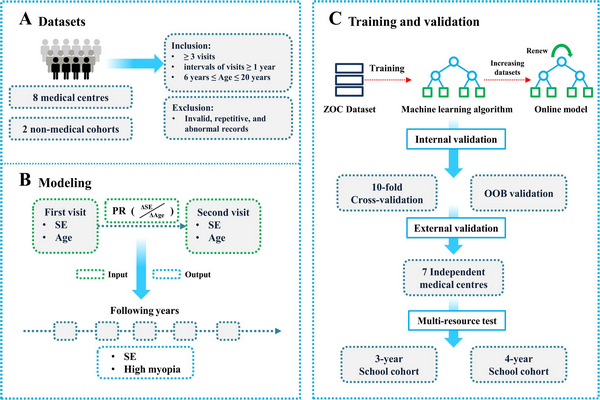
Fig 1. Overall study pipeline. (A) Eight ophthalmic centres and 2 non-medical (population-based) cohorts were included. To focus on the school-aged population, only individuals aged from 6 to 20 years at the initial examination, with ?3 visits at ?1-year intervals were included in the analysis.
(B) Candidate predictors included age at examination, SE, and annual progression rate. Using these predictors, the algorithm was used to predict SE and whether patients will progress to high myopia in the subsequent 10 years (with each year as a predictive time point).
(C) We used the random forest method of machine learning to establish a prediction algorithm. All records from ZOC were used as the training set. Ten-fold cross-validation and OOB methods were applied for internal validation. The remaining records from the other 7 centres and 2 independent population-based datasets were used for external validation and the multi-resource test, respectively. PR, annual progression rate;
OOB, out-of-bag; SE, spherical equivalent; ZOC, Zhongshan Ophthalmic Centre.
In order to transform the research from bench to bed, the research team developed an artificial intelligence cloud platform to provide efficient myopia prediction services. By visiting the intelligent platform and inputting the age and degree of two examinations (at least one year apart), the change of myopia degree and the risk of high myopia in 10 years can be predicted.
Zhongshan Ophthalmic Center of Sun Yat-sen University has been devoted to myopia research in recent years and made breakthroughs continuously. The achievements aroused increasing social attention and has significant impact. Our previous research on the incidence of myopia among primary and secondary school students (
JAMA Ophthalmology, 2018) was reported by foreign media and reprinted as “The high incidence of myopia among Chinese students urgently needs intervention” by
Cankaoxiaoxi. General Secretary Xi Jinping gave instructions after reading this article, “The whole society should take action to take good care of children’s eyes together and let them have a bright future” (Xinhuanet, 2018.08.28). Besides, we have also proved for the first time that increasing outdoor activities can slow down the occurrence and development of myopia (
JAMA, 2015), which has been included in the World Health Organization
Blue Paper on Myopia Prevention and Control, the National Health Commission’s Eye Health Planning, the Ministry of Education's Youth Myopia Prevention and Control, and other policy guidelines.
Our research achievements using big data provide standards for prevention and control of myopia in school-aged children: myopia develops fastest at school age, when we should minimize children’s close reading and increase their outdoor activities. we can never achieve effective prevention and control of school-aged myopia without efforts from the whole society.
Attachment:
PLoS Medicine is an international authoritative comprehensive medical journal with an impact factor of 11.675, which belongs to Q1 in Chinese Academy of Sciences and JCR Medicine. This magazine mainly publishes medical research with sustained impetus and potential for transformation and application in medical and public health, aiming at promoting multidisciplinary cooperation, synergy innovation and improving human health issues.
Link to the paper:
https://journals.plos.org/plosmedicine/
https://journals.plos.org/plosmedicine/article/file?id=10.1371/journal.pmed.1002674&type=printable




 COPYRIGHT?1999-2017 , SUN YAT-SEN UNIVERSITY