Zhongshan Ophthalmic Center Proved Correlation between Green Exposure and Children Myopia Using Spatial Technology
Source: Zhongshan Ophthalmic Center
Edited by: Tan Rongyu, Wang Dongmei
Due to social progress and environmental changes, the myopia rate of children and adolescents in China has reached 52.7% in 2020, ranking first in the world and making it a major national public health problem. Studies have shown that children from urban areas have 2.6 times higher odds of having myopia than those from rural areas that are characterized by more green environments. Therefore, whether the myopia incidence and development in children is related to the green space exposure is worth investigating. Based on the interdisciplinary platform of Sun Yat-sen University, a team led by Prof. Lin Haotian from Zhongshan Ophthalmic Center united 20 top domestic and foreign scientific institutions in the fields of medical care, remote sensing and intelligent imaging analysis,using Gaofen-2, China’s first optical remote sensing satellite with 1-meter-high resolution to clarify the relationship between green exposure and myopia in school-age children. The research paper "Spatial Technology Assessment of Green Space Exposure and Myopia" was published online on August 2, 2021 in
Ophthalmology (impact factor: 12.08), the top international journal of ophthalmology, opening up a population-based environmental prevention model for myopia.
Using remote sensing technology and big data analysis to promote researches focusing myopia prevention and control
In recent years, myopia prevention and control has become a hotspot. However, the previous researches on child myopia were restricted to small samples.
Over the past decades, spatial technology has revolutionized the discipline of epidemiology and its application in human health. Geographic information systems have been utilized to judge the epidemic situation of COVID-19. In addition, satellite communication has been used for telemedicine. Furthermore, remotely sensed data has been used to investigate the long-term effects of environmental factors on health-related states and events and the underlying mechanisms. In this study, the team applied high-resolution remote sensing technology to accurately quantify the green exposure of hundreds of schools in Shenzhen. Used multiple scenes of remote sensing images, the team integrated time-series dynamics into the green space exposure to consider the changes in seasonal greenness and urbanization changes during the study period. Furthermore, based on myopia large-scale cohort study, the team used big data to clarify the relationship between the greenness of schools and both the prevalence and incidence of myopia. This research will enhance the application of digital technology and remote sensing to tackle a major, global public health challenge and augment and enhance public health strategies.
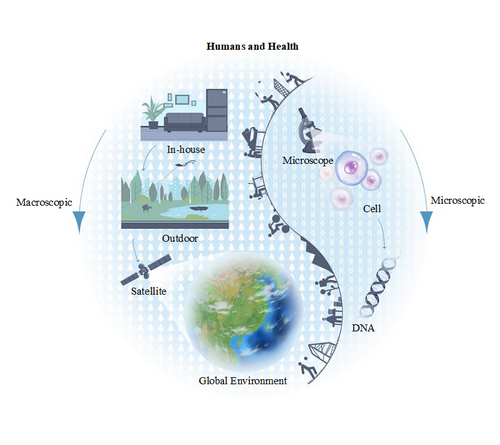
Figure 1. Research methodology for humans and health
Myopia is a leading cause of visual impairment affecting nearly 1.89 billion people worldwide. Increased digital screen time and closer distance to the screens at work were found to be associated with myopia and could potentially be aggravated during and beyond the COVID-19 pandemic outbreak period. A greater understanding of this relationship could aid in environmental planning and public policy initiatives that may help reduce myopia during and beyond this outbreak. With the support of the Rescue Eyes Service Centre in Shenzhen, Prof. Lin’s team constructed a prospective cohort including 142,865 students, and calculated the Normalized Difference Vegetation Index (NDVI) based on the multiple scenes of Gaofen-2 remote sensing image to accurately assess green space exposure. Our study showed that at the school level, a 0.1 increase in NDVI was associated with a 3.6% lower increase in the school myopia prevalence. In particular, for non-myopia students, 0.1 increase in NDVI was associated with a 19.8% reduction in the myopia risk. In addition, the team found that if the NDVI of all schools were increased to 0.3 or above, the overall myopia prevalence would be reduced by about 4 percentage points per year. This would be sufficient to achieve the ideal myopia prevalence reduction suggested by the Ministry of Education (MOE) in China.
Thus, this work will arouse the attention of parents, schools, and medical institutions to the impact of environmental green space on the visual health of children and may help policymakers develop group intervention strategies, thereby restraining the global prevalence of myopia.
The interdisciplinary platform opens up a population-based environmental prevention model for myopia
In recent years, interdisciplinary cooperation has provided a diverse theoretical foundation and perspective with numerous creative research findings. Based on the interdisciplinary platform of medicine and geography, the team used the Gaofen-2 remote sensing satellite to capture Shenzhen’s multi-spectral data and conducted a large-scale prospective cohort to achieve the combination of remote sensing system and medical big data to evaluate the impact of the environmental factors on students at a macroscopic level. This project will open up a population-based environmental prevention model for myopia.
Providing insights into environmental health, the research findings may help policymakers develop population-based prevention strategies, such as increasing school green space to improve the vision health of school-age children. Group intervention for myopia could produce public health benefits on a large scale and may be more economically viable than traditional optical and pharmacological myopia interventions that require individual compliance. The interdisciplinary platform brings more possibilities for the development of medicine. In the future, we believe that remote sensing systems can solve problems and provide new ideas for scientific research.
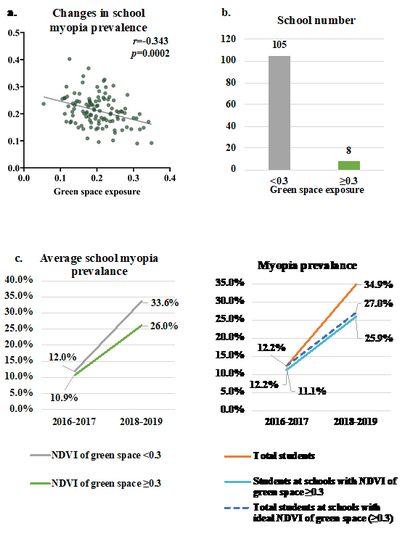
Figure 2. The main results
The research team is led by Prof. Lin Haotian from the Zhongshan Ophthalmic Center of Sun Yat-sen University (corresponding author), with the participation and guidance of Prof. Ian George Morgan from the Australian National University, Prof. Liu Yizhi, Prof. He Mingguang from the Zhongshan Ophthalmic Center, Prof. Tien Yin Wong, Prof. Daniel Shu Wei Ting from the Singapore National Eye Center, and the efforts of five co-first authors of the Zhongshan Ophthalmic Center, Dr. Yahan Yang, postdoctoral fellow Chen Wenben, graduate student Xu Andi, associate researcher Zhao Lanqin, and associate professor Ding Xiaohu.
The research is funded by the National Natural Science Foundation of China (81770967 and 81822010), the Science and Technology Planning Projects of Guangdong Province (2018B010109008) and Sanming Project of Medicine in Shenzhen (SZSM201812091).
Link to the paper:
https://doi.org/10.1016/j.ophtha.2021.07.031




 COPYRIGHT?1999-2017 , SUN YAT-SEN UNIVERSITY