The team of Prof. Wenqing Zhang in Sun Yat-sen University found that peroxiredoxin alleviates fitness costs of imidacloprid resistance in Nilaparvata lugens, an insect pest of rice
Source: School of Life Sciences
Edited by: Tan Rongyu, Wang Dongmei
Arthropod pests cause serious damages to both agriculture and human health. Management of these pests is heavily reliant on chemical insecticides in most countries. Such over-reliance of insecticides leads to widespread evolution of insecticide resistance. The evolution of insecticide resistance may undergo two sequential stages. Stage one selects/accumulates the genetic/genomic mutations that directly cause insecticide resistance. Almost all the studies today are focused on this stage and have found that those resistance-conferring mutations often impose fitness costs that lead to disappearance of resistance if field application of the corresponding insecticide is stopped right after the emergence of resistance to that insecticide. Continuous use of the corresponding insecticide will drive evolution of resistance into Stage two that selects for compensatory modifier genes/alleles to alleviate the fitness costs and thus stabilize the resistance in the pest populations. This will render the persistence of resistant pest populations in the field in the absence of insecticides, and thus make the involved insecticide no longer effective against the pest for good. However, little is known about how the modifier genes/alleles evolve and function to overcome the fitness costs of insecticide resistance.
Recently, the team of Prof. Wenqing Zhang (School of Life Sciences, Sun Yat-sen University) published a research article entitled “Peroxiredoxin alleviates the fitness costs of imidacloprid resistance in an insect pest of rice” in
PLoS Biology, a major journal in the field of biology. This article reported that peroxiredoxin is a modifier gene that alleviates the fitness costs of imidacloprid resistance in
Nilaparvata lugens, the most voracious pest of rice.
Through the genomic resequencing and selective sweep analysis, they found that
N. lugens peroxiredoxin
(NlPrx) was strongly selected in insecticide-resistant individuals and a potential modifier allele T65549 within the promoter region of this gene was identified. The T65549 allele could upregulate the expression of
NlPrx gene.
Subsequent results showed that overexpression of P450s not only confers imidacloprid resistance in
Nilaparvata lugens, the most voracious pest of rice, but also leads to elevated production of reactive oxygen species (ROS) through metabolism of imidacloprid and host plant compounds. The inevitable production of ROS incurs a fitness cost to the pest. While
N. lugens individuals carrying T65549 allele could upregulates the expression of
NlPrx and thus increases resistant individuals’ ability to clear the cost-incurring ROS of any source (Figure 1). This represents the first functional characterization of such fitness costs-overcoming modifier genes/alleles of insecticide resistance. This pioneer study may prompt a study shift from focusing on Stage one to both stages of resistance evolution of pests to insecticides.
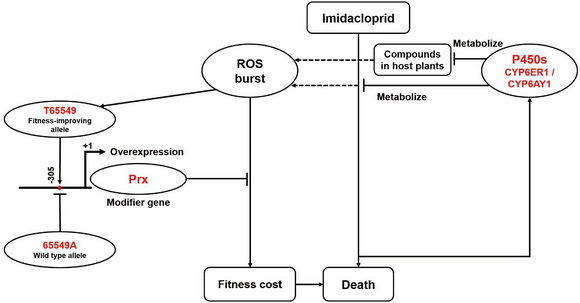
Figure 1. A working model for the sequential evolution of the overexpression alleles of P450s and NlPrx as well as their contributions to resistance of N. lugen to imidacloprid.
Prof. Wenqing Zhang from Sun Yat-sen University and Prof. Xianchun Li from University of Arizona (Tucson, USA) are the corresponding authors of this article. Dr. Rui Pang is the first author, and School of Life Sciences, Sun Yat-sen University is the first unit. Drs. Ke Xing, Longyu Yuan, and Zhilun Liang from Sun Yat-sen University, and Research fellow Yan Ling from Guangxi Academy of Agricultural Sciences take part in this research. This work was supported by National Natural Science Foundation of China (Grant 31730073), Science and Technology Planning Project of Guangdong Province, China (Grant 2016A050502021) and USDA National Institute of Food and Agriculture.
Link to the paper:
https://journals.plos.org/plosbiology/article?id=10.1371/journal.pbio.3001190





 COPYRIGHT?1999-2017 , SUN YAT-SEN UNIVERSITY