Source:
phys.org/news/2015-04-adding-transparency-graphene-paper-supercapacitor.html
Written by: Lisa Zyga
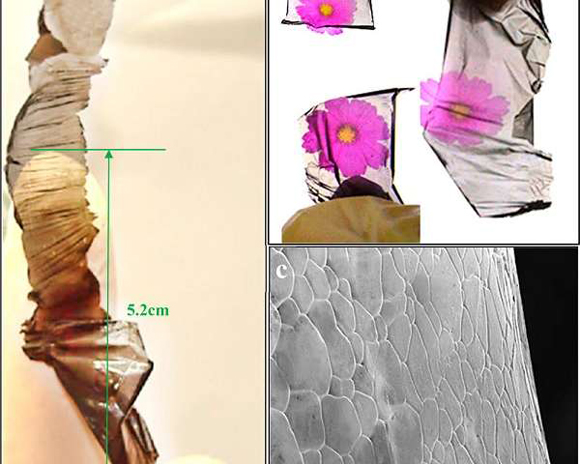
(a, b) Photographs and (c) an SEM micrograph of the new material: flexible, freestanding, and transparent graphene paper. In (b), the Sun Yat-sen University logo is clearly seen behind the transparent graphene sheet. Credit: Na Li, et al. @2015 American Chemical Society
(Phys.org)—For the first time, scientists have integrated transparency into freestanding, flexible graphene paper (FFT-GP), and demonstrated that the new material can greatly improve the performance of supercapacitors.
"Freestanding flexible and transparent graphene paper was synthesized for the first time, and the capacitance was improved by nearly 1000-fold compared with that of the laminated or wrinkled chemical vapor deposition graphene-film-based supercapacitors," Chengxin Wang, Professor at Sun Yat-sen (Zhongshan) University in Guangzhou, China, told
Phys.org. "The capacitance for the supercapacitors based on FFT-GP is also at least ten times greater than previously reported values for transparent and flexible supercapacitors based on pure carbon materials. However, some carbon-based nontransparent supercapacitors still perform better than the FFT-GP-based transparent supercapacitor."
Wang and his coauthors have published a paper on the new material in a recent issue of
Nano Letters.
The improved performance stems in large part from the prism-like graphene building blocks that the FFT-GP is made of. The hollow structures of the prism-like graphene that give the material its transparency also provide additional space for chemical reactions to occur compared to other materials. In addition, the aligned and interconnected prism-like structures provide a wide open freeway for ions and electrons to travel along, and the good charge transport leads to an overall better performance.
To make the new material, the researchers had to overcome the biggest obstacle facing the synthesis of thin, transparent graphene sheets, which is that the sheets fracture easily when being removed from their template. Here, the researchers used NaCl powder—essentially finely ground table salt—as the template for FFT-GP growth. Using a method called microwave plasma-enhanced chemical vapor deposition, the researchers created a "plasma atmosphere" of NaCl, carbon, and hydrogen. At the end of this process, the NaCl is allowed to recrystallize on a silicon substrate. These NaCl crystals serve as templates upon which graphene fragments form and grow into prism-like graphene, which can be peeled off the substrate using a razor blade.
Two supercapacitors placed across a smartphone screen demonstrate optical transparency while powering an LED. Credit: Na Li, et al. ?2015 American Chemical Society
Although the FFT-GP created here is somewhat wrinkly and has a light brown color, the researchers demonstrated that it can still withstand more than 1,000 bending and stretching cycles with little capacity loss, and still clearly transmits light. The researchers also demonstrated a tandem device made of two integrated FFT-GP-based supercapacitors placed over a smartphone screen (to demonstrate transparency) that lights up an LED.
The material's combination of flexibility, transparency, electrical conductivity, and large surface area open the doors to many new potential applications, such as stretchable and transparent solar cells, rolled-up displays, and self-powered and wearable optoelectronics. The hollow structure of the prism-like graphene could also be exploited for other uses, such as storing more light-absorbing dye in dye-sensitized solar cells. The researchers plan to explore these possibilities in the future.
"First, we are trying to use FFT-GP in dye-sensitized solar cells," Wang said. "Due to its hollow and porous prism-like graphene building blocks with large efficient surface area, larger amounts of light-absorbing dye could be stored than in other graphene materials. Maybe this design is a better solution to improve the dye adsorption and to enhance the light trapping and scattering capability compared to other graphene materials. Second, FFT-GP-based high-theoretical-capacitance composites will be synthesized to improve the energy density of FFT-GP-based transparent supercapacitors. Third, FFT-GP could be applied as lithium-ion battery anodes, and then a transparent all-solid-state lithium-ion battery can be developed."
More information: Na Li, et al. "Free-Standing and Transparent Graphene Membrane of Polyhedron Box-Shaped Basic Building Units Directly Grown Using a NaCl Template for Flexible Transparent and Stretchable Solid-State Supercapacitors."
Nano Letters. DOI: 10.1021/acs.nanolett.5b00364